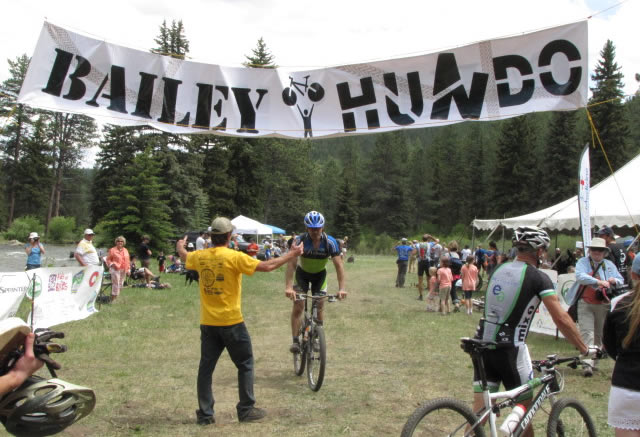
Bailey Hundo Race Report June 2011 |
|
The weather shaped up to be perfect, a cool front had delivered a little moisture to the trail the evening before the race, and the temperature was in the 70’s. I had been training for this day for 5 months. With a hill climb race and a century ride the weekend before, I was a little concerned that my legs would not be fully recovered for the Hundo (risk factor #1).
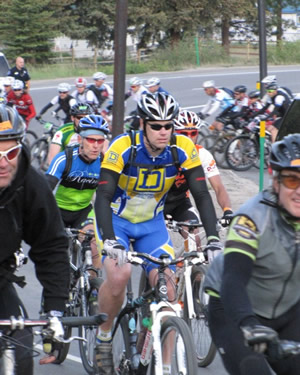
In the morning it was chilly, about 42 degrees and humid. I made the decision to travel light this year, with only a 50 oz water bag filled with Accelerade and some food in my jersey pockets. I would rely on the aid stations for ALL water (risk factor #3). After a short ride to the start line in downtown Bailey, I joined up with a couple team mates and waited for the gun to go off. At the gun, the pros and other top racers took off fast. I worked my way up through the pack and positioned myself just behind the lead pack. My heart rate went to max as soon as we made our way up the first hill, so I had to back off. I rode to my heart rate of 90% to 92% for the entire dirt road stretch all the way up the three big hills to the start of the single track. Going that hard for the first 36 minutes had me a little concerned for the rest of the race (risk factor #4). Once on the single track I kept the pace high, and knew that there would be some chance to recover with the short descents ahead. The last part of the Colorado Trail before Aid Station #1 got bunched up, so the pace slowed, this allowed me to recover from the first hard hour of effort. It would have been difficult to pass on this section, so I just rode with the pack and enjoyed the trail and the “rest”. At Aid Station #1 I grabbed a water bottle without slowing down and put it in my empty bottle cage. This was my water plan for the day; throw an empty bottle and pickup a new full water bottle without slowing down at each of the 10 Aid Stations. The next section of single track was lower Gashaus and then up the Baldy climb. The moisture from rain the day before made this section of trail even faster than usual, and the climb up Baldy offered good traction. Again at Aid Station #2 I threw an empty bottle and picked up a new one from one of the awesome volunteers. I had no appetite until about this time, so I started sipping on the Accelerade in my water bag and eating a small red potato from my jersey pocket. I had prepped several Lara and Power bars by taking them out of the wrapper and stowing them in a small bag attached to my top tube for easy access, this worked great.
This segment was a steady gradual uphill double track all the way to Aid Station #4, where I kept a high heart rate and repeated my throw a bottle and take a full bottle routine again without stopping. After passing through the Meadows area, we were faced with the Green Mountain climb. I was forced into the granny gear for a short while, but managed most the climb in middle ring with a high and steady heart rate. The descent on the backside of Green Mountain was technical and fast, again I was able to pass three or four racers who were not as confident on this type of trail. The fun and rolling single track continued along the Colorado Trail for a long ways, finally we hit Aid Station #5, where I again swapped bottles without slowing down. Next up was the new Buffalo Burn trail and the transition across Highway 126 to resume the Colorado Trail, and the long undulating single track to the north. This was a fun section hour long section where I rode with three other guys most of the way to the start of the huge descent down to the Platte River. This steep stretch was the most hazardous as it is loose, rocky and eroded. I took it a little slower so that there would be no accidents. The last mile to the river had six 180 degree switchbacks where it would be impossible to pass, so most riders just kept their pace, and did their best not to spend excess energy or crash. The refuel point at Aid Station #6 was the first time I touched the ground all day (over 5 hours). My refuel bag was waiting for me, where I took on more potatoes and bars. My entire 50 oz of concentrated Accelerade was gone, so I took on 45 ounces of Perpetuem in my water bag and pumped up my rear tire to 45 from 35 psi. I joined with a teammate and three other guys with the plan to form a pace line and take advantage of the better aerodynamics of a group so that we could get ourselves the 13 miles to Deckers as fast as possible. We did stay together the whole way, but since I was challenged to stay with this group, I had to work too hard to keep up; I did keep up, but was afraid that the extended period of time above 90% heart rate (21 mph) might cost me later (risk factor #5).
As I began the descent from Stoney Pass my timer read 8:10, I knew that there was less than an hour to race, so I realized for the first time that I was on a sub-9 hour pace. I consumed a 380 calorie Pro Bar, washed it down with Heed, and picked up the pace for the next 30 minutes on the dirt road past Wellington Lake, right on through Aid Station #10 without slowing down. The last big climb was at mile 98, to the top of Insmont Hill. At this time I was feeling it in the legs, could not keep my heart rate above 80%, and was losing concentration. At the top, the course turned right towards the finish area onto a narrow, rough and eroded double track road that had been recently improved with a tractor. I thought to myself this would be a bad place to fall. At that instant my front wheel entered an erosion channel, hit a 6 inch loose rock, and sent me cart wheeling onto the rocks at 20 mph. I landed on my right forearm, then my right hip, luckily my hip bone missed a fixed rock and smashed my thigh muscle instead. It took me seven minutes to get up, check myself out, pickup stuff that was strewn all over the trail and straighten out the bike. After deciding that I could keep riding, I carefully rode the last half mile of the course to a beautiful finish area in a private meadow right on the river with the band playing.
The medical staff suggested I go soak in the cold water of the river, so I did that, which made the legs feel better and slowed the swelling of the right thigh. I promised that I would do RICE (rest, ice, compression, elevation) therapy for a couple weeks. They cleaned and bandaged the forearm and upper leg, and then I headed over to the tent for a burger and beer. I was 3rd place in the fund raising effort, thanks to many friends that had made donations to the race charitable organizations, so I got to stand on the podium for that reason, but missed the real podium by one place!
|
Bob Campbell Bailey Hundo race report - June 18th, 2011 |
 I went up to the Bailey area the evening before the race.
Checked into the Lynwood B&B just west of town and headed up to the Romer Ranch
for the pre-race BBQ. I helped myself to a huge plate of rice, beans, pulled
pork, beef brisket and smoked sausage, way too much food (risk factor #2).
I went up to the Bailey area the evening before the race.
Checked into the Lynwood B&B just west of town and headed up to the Romer Ranch
for the pre-race BBQ. I helped myself to a huge plate of rice, beans, pulled
pork, beef brisket and smoked sausage, way too much food (risk factor #2). Now I was flying down the dirt road to the start of the
Skipper single track, passed some guys, my race was going well. After Skipper,
the course took us up a jeep trail to Charlie’s Cutoff, then all the way down
the Sandy Wash descent to some new single track towards Buffalo Creek to Aid
Station #3. There were quite a few racers taking on bananas and oranges at Aid
#3, but I stuck to the plan and threw an empty and picked up a full water bottle
without stopping, which allowed me to pass about 8 racers.
Now I was flying down the dirt road to the start of the
Skipper single track, passed some guys, my race was going well. After Skipper,
the course took us up a jeep trail to Charlie’s Cutoff, then all the way down
the Sandy Wash descent to some new single track towards Buffalo Creek to Aid
Station #3. There were quite a few racers taking on bananas and oranges at Aid
#3, but I stuck to the plan and threw an empty and picked up a full water bottle
without stopping, which allowed me to pass about 8 racers.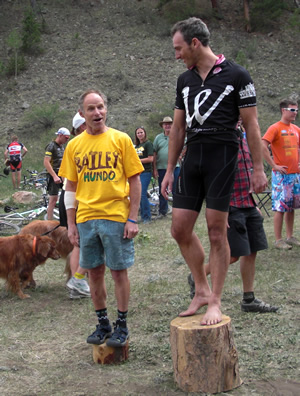 After Deckers the course began the long climb to Stoney
Pass. Some of the steep sections were in the sun, at the heat of the day, so
the goal was just to keep moving and manage liquids. I started to cramp in my
right thigh, so stopped, stretched, put some Hammer electrolyte in my water
bottle and continued on in granny gear. This was the only section of the course
where I saw some racers walking due to the 10%+ grades. Aid Station #8 was at
the top of the first steep pitch and a welcome sight; I took on another water
bottle and loaded it with more electrolytes that solved the cramping problem.
The course continued through the burn area, then to a forest, with at least
five false summits on the way up to the high point of Stoney Pass. I had
planned to do the quick bottle change at Aid Station #9 at the pass, but they
offered cold sweet watermelon and Hammer Heed, so I stopped and enjoyed a slice
and a bottle of Heed.
After Deckers the course began the long climb to Stoney
Pass. Some of the steep sections were in the sun, at the heat of the day, so
the goal was just to keep moving and manage liquids. I started to cramp in my
right thigh, so stopped, stretched, put some Hammer electrolyte in my water
bottle and continued on in granny gear. This was the only section of the course
where I saw some racers walking due to the 10%+ grades. Aid Station #8 was at
the top of the first steep pitch and a welcome sight; I took on another water
bottle and loaded it with more electrolytes that solved the cramping problem.
The course continued through the burn area, then to a forest, with at least
five false summits on the way up to the high point of Stoney Pass. I had
planned to do the quick bottle change at Aid Station #9 at the pass, but they
offered cold sweet watermelon and Hammer Heed, so I stopped and enjoyed a slice
and a bottle of Heed.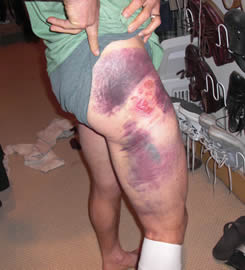 My time last year was 10:05 and 9th place, this
year it was 8:52 and 4th place, all and all a successful day!
My time last year was 10:05 and 9th place, this
year it was 8:52 and 4th place, all and all a successful day!